ODB data conversion
At present, odb4py provides two functions to convert ODB datasets into alternative formats, in addition to direct querying capabilities.
These conversion tools are implemented in the odb4py.convert module.
The following conversion workflows are currently supported:
Conersion from :
ODB to ODB2
ODB to NetCDF
ODB to SQLite
Note
It is important to note that conversion to the ODB2 format is not handled internally by odb4py. Instead, users can pass the extracted data to the encoder available in the pyodc package.
Because data conversion inherently entails both read and write operations, an ODB dataset generated by the global model ARPEGE is used as a benchmark. This provides a representative framework for evaluating the input/output performance of the odb4py.convert module.
Conversion to ODB2
The example below extracts the ASCAT ambiguous v and u component of wind from an ECMA ODB (varno==124 , varno==125) and writes the rows into an ODB2 file.
#-*- coding : utf-8 -*-
from datetime import datetime


from odb4py.core import odb_open , odb_dca , odb_close
from pyodc       import codc

# Start
start = datetime.now()

# ODB path
dbpath ="/path/to/ECMA.ascat"

   # Get some needed attributes
db        = OdbObject ( dbpath )
db_attr   = db.get_attrib()
db_date   = db_attr["observation_date"]  # Observation datetime

dt = db_date.split()[0]  # Date
tm = db_date.split()[1]  # Time

# ODB2 output filename
odb2file="arpege_ascat_"+dt+"_"+tm+".odb2"

# Set up the sql query :  Get the ambiguous U wind component  (obstype =9, codetype=139, varno=124)
sql_query="select  statid ,   \
           degrees(lat)   ,\
           degrees(lon)   ,\
           varno          ,\
           obstype        ,\
           codetype       ,\
           date           ,\
           time           ,\
           obsvalue       ,\
           vertco_reference_1,\
           vertco_reference_2,\
           datum_status.active@body , \
           datum_status.blacklisted@body,   \
           datum_status.passive@body, \
           datum_status.rejected@body,\
           FROM hdr,body  WHERE obstype==9 AND codetype==139 AND varno ==124  ORDER BY   date,time"


#Parse the query
p  =SqlParser()
nf =p.get_nfunc    ( sql_query )
sql=p.clean_string ( sql_query )

# Create a connection object
conn = odb_open( dbpath )

# Fetch the rows as a dictionary
rows = conn.odb_dict ( database =  dbpath ,
                sql_query= sql     ,
                nfunc    = nf      ,
                fmt_float= 10      ,
                queryfile= None    ,
                poolmask = None    ,
                pbar     = True    )


# Build the dataframe
df = pd.dataFrame(  rows )

# Encode into the ODB2 file
encode_odb(df, odb2file ,  rows_per_frame= 1000 )

# Close the odb
conn.odb_close()

# End
end = datetime.now()
total_duration = end -  start
print("Runtime duration:" , duration  )
Output
[##################################################] Complete 100%  (Total: 684451 rows)
--odb4py : ODB database closed.
Runtime duration: 0:00:12.325594
Check the output ODB2 file
The output ODB2 file can be checked using the ECMWF odc tool and visualied with metview or Python directly.
odc  count  ascat_arpege_20240623_000000.odb2
684451

odc sql -i ascat_arpege_20240623_000000.odb2 'select *  WHERE  rownumber() < 10'

obstype@hdr  date@hdr datum_status.passive@body  codetype@hdr  time@hdr datum_status.blacklisted@body statid@hdr datum_status.active@body datum_status.rejected@body  degrees(lat)    degrees(lon)   obsvalue@body     varno@body
          9        20240622                          0                  139          210000                              0   '     005'                             1                                 0           15.649060     -173.493550       -8.012632             125
          9        20240622                          0                  139          210000                              0   '     005'                             1                                 0           15.649060     -173.493550       -2.087134             124
          9        20240622                          0                  139          210000                              0   '     005'                             1                                 0           15.649060     -173.493550        7.754457             125
          9        20240622                          0                  139          210000                              0   '     005'                             1                                 0           15.649060     -173.493550        1.283742             124
          9        20240622                          0                  139          210000                              0   '     005'                             0                                 1           15.695730     -173.721710       -7.765099             125
          9        20240622                          0                  139          210000                              0   '     005'                             0                                 1           15.695730     -173.721710       -2.197302             124
          9        20240622                          0                  139          210000                              0   '     005'                             0                                 1           15.695730     -173.721710        7.429603             125
          9        20240622                          0                  139          210000                              0   '     005'                             0                                 1           15.695730     -173.721710        1.552125             124
          9        20240622                          0                  139          210000                              0   '     005'                             0                                 1           15.742160     -173.949980       -7.635057             125
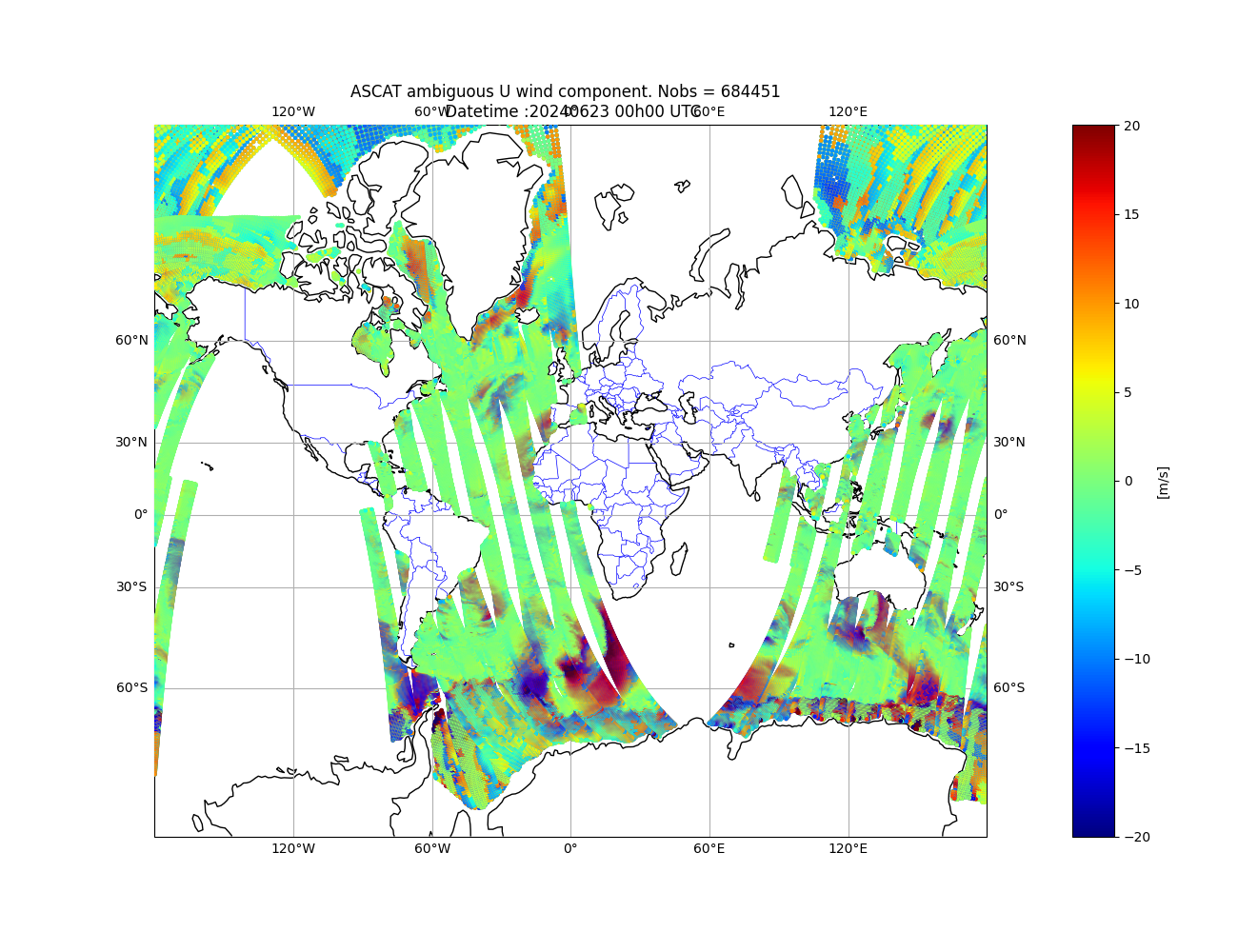
Example : ASCAT satellite from an ARPEGE ECMA ODB converted to ODB2.
Convert ODB to NetCDF format
To perform the conversion into NetCDF format the odb_to_nc function has to be called. The data encoding is handled in the backend, ensuring compatibility with the ODB internal format. The NetCDF variables are automatically created by mapping the data types returned by the ODB query to the corresponding types supported by the latter.
ECMA.ascat is used also in the following example.#-*- coding : utf-8 -*-
from datetime import datetime
# utils
from odb4py import SqlParser
# Import the method
from odb4py.convert import odb_to_nc
# Start
end = datetime.now()
# ODB path
dbpath ="/path/to/ECMA.ascat"
# Get some needed attributes
db = OdbObject ( dbpath )
db_attr = db.get_attrib()
db_tables = db_attr ["tables"]
db_date = db_attr ["observation_date"] # Observation datatime
# NetCDF filename
dt = db_date.split()[0] # Date
tm = db_date.split()[1] # Time
# Output filename
ncfile = "arpege_ascat_"+dt+"_"+tm+".nc"
# Set up the sql query : Get the ambigous U wind component (obstype =9, codetype=139, varno=124)
sql_query="select statid , \
degrees(lat) ,\
degrees(lon) ,\
varno ,\
obstype ,\
codetype ,\
date ,\
time ,\
obsvalue ,\
vertco_reference_1,\
vertco_reference_2,\
datum_status.active@body , \
datum_status.blacklisted@body, \
datum_status.passive@body, \
datum_status.rejected@body,\
FROM hdr,body WHERE obstype==9 AND codetype==139 AND varno ==124 ORDER BY date,time"
#Parse the query
p =SqlParser()
nf =p.get_nfunc ( sql_query )
sql=p.clean_string ( sql_query )
# Fetch the data and convert to NetCDF
status =odb_to_nc(database =dbpath , # (dtype -> str ) ODB path
sql_query=sql , # (dtype -> str ) The sql query
nfunc =nf , # (dtype -> integer ) Number of functions found in the sql query
outfile =ncfile , # (dtype -> str ) The output NetCDF file
rows_per_chunk = 1000, # (dtype -> int ) The number of written rows per chunk ( default is 5000)
zip_level = 5 , # (dtype -> int ) Zlib compression level (1 to 9 )
poolmask = None , # (dtype-> str ) Poolmask
queryfile= None , # (dtype-> str ) Sql query file
pbar = True , # (dtype -> boolean) Show the progress bar
verbose = True ) # (dtype -> boolean) verbosity on/off
# End
end = datetime.now()
duration = end - start
print("Runtime duration:" , duration )
List of column names in  arpege_ascat_2024062300.nc
Column   :  statid_hdr
Column   :  lat_hdr
Column   :  lon_hdr
Column   :  varno_body
Column   :  obstype_hdr
Column   :  codetype_hdr
Column   :  date_hdr
Column   :  time_hdr
Column   :  obsvalue_body
Column   :  an_depar_body
Column   :  vertco_reference_1_body
Column   :  vertco_reference_2_body
Column   :  datum_status_active_body
Column   :  datum_status_blacklisted_body
Column   :  datum_status_passive_body
Column   :  datum_status_rejected_body
ODB data have been written to file : arpege_ascat_2024062300.nc
File size  : 6466010  Bytes

Runtime duration: 0:00:03.98810
The ncdump -h command show the structure, the data and metadat of encoded data.
netcdf arpage_ascat_2024062300.nc {
dimensions:
     obs = UNLIMITED ; // (85536 currently)
     strlen = 8 ;
variables:
     char statid_hdr(obs, strlen) ;
     double lat_hdr(obs) ;
             lat_hdr:units = "degrees_north" ;
             lat_hdr:standard_name = "latitude" ;
     double lon_hdr(obs) ;
             lon_hdr:units = "degrees_east" ;
             lon_hdr:standard_name = "longitude" ;
     int64 varno_body(obs) ;
     int64 obstype_hdr(obs) ;
     int64 codetype_hdr(obs) ;
     int64 date_hdr(obs) ;
             date_hdr:Format = "YYYYMMDD" ;
     int64 time_hdr(obs) ;
             time_hdr:Format = "HHMMSS" ;
     double obsvalue_body(obs) ;
     double an_depar_body(obs) ;
     double vertco_reference_1_body(obs) ;
     double vertco_reference_2_body(obs) ;
     int64 datum_status_active_body(obs) ;
     int64 datum_status_blacklisted_body(obs) ;
     int64 datum_status_passive_body(obs) ;
     int64 datum_status_rejected_body(obs) ;

 // global attributes:
             :Title = "ODB data in NetCDF format" ;
             :NetCDF_filename = "scat_with_compress_6.nc" ;
             :Conventions = "CF-1.10" ;
             :Data_SQL_query = "select statid , lat , lon , varno , obstype , codetype , date , time , obsvalue , an_depar, vertco_reference_1, vertco_reference_2, datum_status.active@body , datum_status.blacklisted@body, datum_status.passive@body, datum_status.rejected@body, FROM hdr,body WHERE obstype==9 AND codetype==139 AND varno == 124 ORDER BY date,time " ;
             :NetCDF_library_version = "4.9.3 of Mar 14 2025 07:27:28 $" ;
             :History = "Created by: odb4py python package" ;
             :odb4py_version = "1.3.3" ;
             :Institution = "Royal Meteorological Institute of Belgium (RMI)" ;
             :Native_format = "ECMWF ODB" ;
             :featureType = "point" ;
             :File_datetime_creation = "2026-04-18 22:46:13 UTC" ;
             :ODB_analysis_datetime = "2024-06-23 00:00:00 UTC" ;
             :ODB_creation_datetime = "2024-11-04 11:24:13 UTC" ;
             :Number_of_ODB_pools = 32 ;
             :Number_of_considered_ODB_tables = 388 ;
             :ODB_software_version = 48 ;
             :ODB_major_version = 0 ;
Convert ODB to Sqlite database
The function odb_to_sqlite is needed to perform such a conversion. As in the case of NetCDF conversion this function needs no ODBConnection object and all the variables and structures and datatype mapping are handled in the backend
#-*- coding : utf-8 -*-

from datetime import datetime

# Convert module
from odb4py.convert import odb_to_sqlite

# Start
start = datetime.now()

# ODB path
dbpath ="/path/to/ECMA.ascat"

# Set up the sql query :  Get the ambigous U wind component  (obstype =9, codetype=139, varno=124)
sql_query="select  statid ,   \
           degrees(lat)   ,\
           degrees(lon)   ,\
           varno          ,\
           obstype        ,\
           codetype       ,\
           date           ,\
           time           ,\
           obsvalue       ,\
           vertco_reference_1,\
           vertco_reference_2,\
           datum_status.active@body , \
           datum_status.blacklisted@body,   \
           datum_status.passive@body, \
           datum_status.rejected@body,\
           FROM hdr,body  WHERE obstype==9 AND codetype==139 AND varno ==124  ORDER BY date,time"

# Same as the previous example
# ...


#  odb_to_sqlite method
status =odb_to_sqlite (database  = dbpath   ,
                       sql_query = sql_query,
                       outfile   = sqlite_file,
                       table_name= "ASCAT",
                       nfunc     = nf     ,
                       pbar      = True   ,
                       verbose   = True  )

# End
end  = datetime.now()
duration = end -  start
print("Runtime duration:" , duration  )
Runtime duration: 0:00:01.988741
To inspect the SQLite database integrity and the extracted data ingestion, the sqlite3 command-line utility has to be used. The following sqlite commands :
Open the sqlite output database and see whether the datatypes have been correctly mapped from ODB1 to SQLite.
Fetch the first 10 rows from all available columns.
sqlite3 arpege_ascat_2024062300.sqlite
sqlite>.fullschema
CREATE TABLE IF NOT EXISTS "ASCAT" (statid_hdr INTEGER, degrees_lat INTEGER, degrees_lon INTEGER, varno_body TEXT, obstype_hdr TEXT, codetype_hdr TEXT, date_hdr TEXT, time_hdr TEXT, obsvalue_body INTEGER, vertco_reference_1_body INTEGER, vertco_reference_2_body INTEGER, datum_status_active_body TEXT, datum_status_blacklisted_body TEXT, datum_status_passive_body TEXT, datum_status_rejected_body TEXT);

sqlite>.tables
ASCAT

sqlite> select   *   FROM  ASCAT WHERE  degrees_lat BETWEEN 34 AND 60  AND  degrees_lon between -5 AND 15  LIMIT 10;
3|37.3063|5.2333|124|9|139|20240622|210937|0.0320263852790326|101754.512366896||0|0|0|1
3|37.3063|5.2333|124|9|139|20240622|210937|-0.0923374476412209|101754.512366896||0|0|0|1
3|37.34035|5.51212|124|9|139|20240622|210937|0.542813296700668|101786.251421662||0|0|0|1
3|37.34035|5.51212|124|9|139|20240622|210937|-0.493466633364241|101786.251421662||0|0|0|1
3|37.37374|5.79119|124|9|139|20240622|210937|0.667882580297611|101793.058252627||0|0|0|1
3|37.37374|5.79119|124|9|139|20240622|210937|-0.583875525852227|101793.058252627||0|0|0|1
3|37.06644|1.85671|124|9|139|20240622|210941|-0.905055759851888|101702.331313069||0|0|0|1
3|37.06644|1.85671|124|9|139|20240622|210941|0.707447059008582|101702.331313069||0|0|0|1
3|37.18992|2.6865|124|9|139|20240622|210941|-0.507586435107384|101760.207672596||0|0|0|1
3|37.18992|2.6865|124|9|139|20240622|210941|0.517408241576685|101760.207672596||0|0|0|1
Note
By default, the odb_to_sqlite method generates a table called ODB.
To support more dynamic workflows, the table name can be given as an argument.
This flexibility allows users to consolidate results from multiple ODB queries into separate SQLite tables within a single output file.
Multiple tables in one sqlite file
Create multiple SQLite tables according to ODB varno column. The same ECMA is used, however the both components of ambiguous wind u,v will be written in to sqlite tables in the same SQLite file.
#-*- coding : utf-8 -*-
from datetime import datetime

# Import
from odb4py.convert import  odb_to_sqlite

# Path to ODB
dbpath="/path/to/ECMA.ascat"

# Start
start   = datetime.now()
# Same as the previous example
# ...


# The sql query
# Note the substitution of varno in the query  '{}' !
scat_query="select  statid ,\
        lat   ,\
        lon   ,\
        varno          ,\
        obstype        ,\
        codetype       ,\
        date           ,\
        time           ,\
        obsvalue       ,\
        an_depar,      \
        vertco_reference_1,\
        vertco_reference_2,\
        datum_status.active@body , \
        datum_status.blacklisted@body,   \
        datum_status.passive@body, \
        datum_status.rejected@body,\
        FROM hdr,body  WHERE obstype==9 AND codetype==139 AND varno == {}  ORDER BY date,time"


# Declare the obstyses to be extracted
# 124  --> Ambiguous U component of wind
# 125  -->  ''      V      ''

# Declare the varno list
varno_list=["124", "125"]

for var in  varno_list :
    """
    THE PATH TO THE ODB IS THE SAME FOR EVERY OTERATION.
    WE DON'T NEED TO UPDATE THE VARIABLES RELATIVE TO THE PATH
    INSIDE THE LOOP :
    IOASSIGN
    ODB_SRCPATH_CCMA
    ODB_DATAPATH_CCMA
    """

    # Change the SQL query according to varno
    query_by_var = scat_query.format(var )

    # Parsing the query must be updated, since the query is changing for every iteration
    nf  =p.get_nfunc    ( query_by_var )
    sql =p.clean_string ( query_by_var )

    # Table names
    tabname="varno_"+var

    # Convert
    re =odb_to_sqlite(database  =dbpath,
                      sql_query = sql  ,
                      nfunc     = nf   ,
                      sqlite_db = sqlite_output ,
                      table_name= tabname ,
                      pbar      = True ,
                      verbose   = True  )

    # Check if it failed
    if re  != 0 :
       print( "Failed to convert data. ODB :" , dbpath  )
       continue

    # End
    end  = datetime.now()
    duration = end -  start
    print("Runtime duration:" , duration  )
--odb4py : Executing query from string: select statid , lat , lon , varno , obstype , codetype , date , time , obsvalue , an_depar, vertco_reference_1, vertco_reference_2, datum_status.active@body , datum_status.blacklisted@body, datum_status.passive@body, datum_status.rejected@body, FROM hdr,body WHERE obstype==9 AND codetype==139 AND varno == 124 ORDER BY date,time
--odb4py : Number of requested columns : 16
 [##################################################] Complete 100%  (Total: 684451 rows)
ODB data have been written to file : output.sqlite.sqlite
File size  : 55656448  Bytes

--odb4py : Executing query from string: select statid , lat , lon , varno , obstype , codetype , date , time , obsvalue , an_depar, vertco_reference_1, vertco_reference_2, datum_status.active@body , datum_status.blacklisted@body, datum_status.passive@body, datum_status.rejected@body, FROM hdr,body WHERE obstype==9 AND codetype==139 AND varno == 125 ORDER BY date,time
--odb4py : Number of requested columns : 16
[##################################################] Complete 100%  (Total: 684451 rows)
ODB data have been written to file : output.sqlite.sqlite
File size  : 111308800  Bytes

Runtime duration: 0:00:10.348313
A table is created for each varno inside the same SQLite file.
sqlite3   arpege_ascat_uv_2024010400.sqlite   .tables
varno_124  varno_125